Monday, May 25, 2015
Reproducing the iOS 7 Home screen using Microsoft Word video

Gotta hand it to Vaclav Krejci, by sheer force of will and commitment to concept, he bent one of the most unwieldy apps in the history of computing into a pretty good static duplicate of iOS 7s Home screen.
Insane.
Data source: via iMore (Rene Ritchie)
Origine source: Youtube

Sunday, May 24, 2015
Live Video Stream of the Apples Worldwide Developers Conference
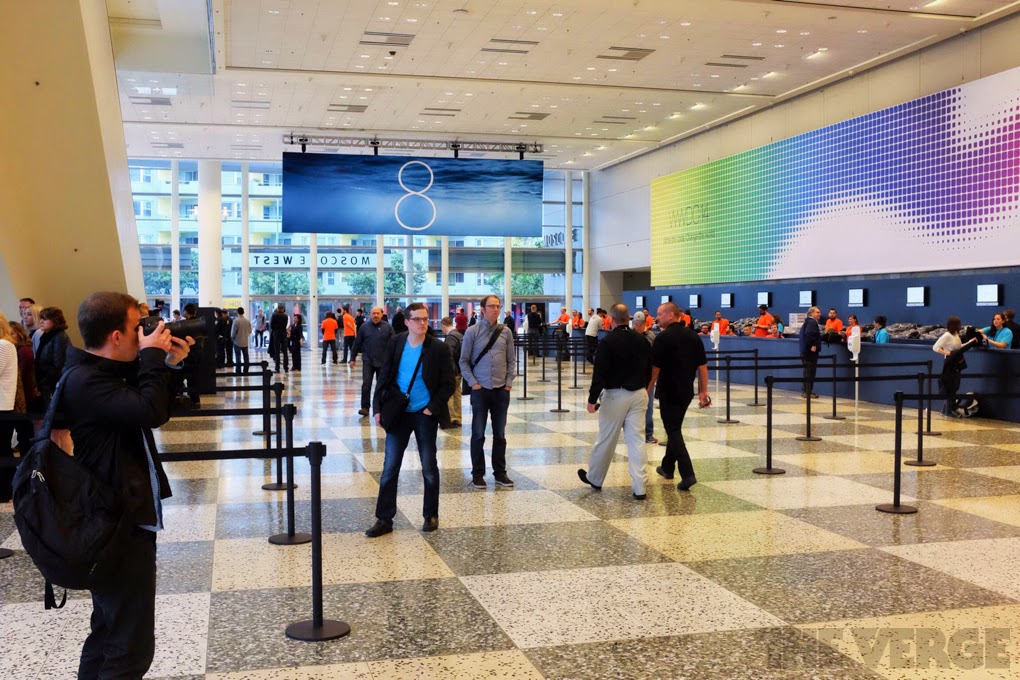
Live video stream of the Apples Worldwide Developers Conference (WWDC) Keynote.
The Verge WWDC live blog
Saturday, May 23, 2015
Steve Jobs On Android Founder Andy Rubin Big Arrogant

Steve Jobs did not like Android, or the guy that ran it, Andy Rubin, according to a new book on the Google-Apple smartphone wars.
Jobs told friends that he thought Rubin was a "big, arrogant f**k," according to Fred Vogelsteins, Dogfight: How Apple And Google Went To War And Started a Revolution.
When Apple introduced the iPhone in 2007, Google was already working on Android, its own smartphone operating system. Google bought Android, which was Rubins startup, for ~$50 million in 2005.
According to Dogfight, when Apple announced the iPhone, Rubin realized he would have to throw out what he was thinking of launching.
He was in a cab in Las Vegas, watching a webcast of the presentation. He made the driver pull over so he could see the whole thing. He said, "Holy crap, I guess were not going to launch that phone."
Ethan Beard, an early Android business development executive told Vogelstein, "We knew that Apple was going to announce a phone. Everyone knew that. We just didnt think it would be that good."
Google had phone software that was ready to launch at the end of the year, but it looked awful relative to the iPhone, so it was all scrapped and delayed. "What we had looked so ... nineties," said an Android engineer.
The Android team got to work and created the software that eventually went into the HTC G1, Googles first Android-based phone. The software was not as good as the iPhone, but it similar enough to Apples software that Jobs was furious with Google.
"Everything is a f**king rip off of what were doing," Jobs said of Android, according to Vogelsteins reporting.
Jobs had trusted Googles cofounders, Larry Page and Sergey Brin. Googles CEO Eric Schmidt was on Apples board. All three has been telling Jobs about Android, but they kept telling him it would be different from the iPhone. And for some reason he believed them until he actually saw the phone and its software.
Once Jobs saw Androids software, and how similar it was to the iPhone, he insisted Google make a lot of changes.
There was a meeting with Jobs, Scott Forstall, who designed the iPhones software, and Googles Larry Page, Alan Eustace, and Rubin. Vogelstein cautions that it was hard to know exactly what happened in the meeting, but says that it was confrontational and nasty.
"It got incredibly personal," says one Apple executive who was briefed by Jobs on the meeting. "Jobs said that Rubin was steamed, telling him his position was anti-innovation. And this is where Steve was demeaning to Andy, saying Andy was trying to be like him, look like him, have the same haircut, the same glasses, the same style."
Apple got what it wanted from the meeting. Google didnt do multitouch features like pinch to zoom. It forced Google to change how it was going to make the phone unlock. Not only did Jobs tell Google what it couldnt use, but according to Vogelstein Jobs told Google how to take things out of Android. It was a complete capitulation from Google.
Rubin was furious that his bosses caved to Jobs. He thought there was plenty of evidence that Apple didnt invent the things it said it invented. Rubin considered quitting Google, but didnt. (Ultimately, Google did add in those features and now its dealing with lawsuits.)
After the meeting with Jobs, he had a sign on his office white board that said, "STEVE JOBS STOLE MY LUNCH MONEY."
In the long run, Rubin and Android got the best of Apple. Android has taken over the world.
(Though the iPhone is wildly profitable. So, for now, this seems to be a rare instance where both companies are doing well.)
Data source: via BI (By Jaw Yarow)
Friday, May 22, 2015
Apple Releases iOS 7 0 2 with Fix for Lock Screen Passcode Bypass

- Fixes bugs that could allow someone to bypass the Lock screen passcodeApple has detailed the two passcode issues fixed in this update in a new support document.
- Reintroduces a Greek keyboard option for passcode entry
The iOS 7.0.2 release follows the launch of iOS 7 on Wednesday, September 18. That day also saw a special release of iOS 7.0.1 specifically for the iPhone 5s and iPhone 5c, which launched on Friday, September 20.
Data source: via MacRumors (By Eric Slivka)
Thursday, May 21, 2015
Alleged iPhone 6 Prototype Update Fake

It is entirely unclear whether the device in the images is a legitimate iPhone 6 prototype or whether it is a fake. Early prototypes of the iPhone 5s and the iPhone 5c exhibited a blank rear shell while the iPhone 6 shell in the picture clearly shows FCC text that is generally added to the phone at a later date. There are also no plastic or glass cutouts for an antenna, something the current-generation iPod Touch -- which sports a similar aluminum-bodied design -- has next to its rear-facing camera.
The device depicted in the images has an approximate width of 2.6 inches, while the existing 4-inch iPhone 5s has a width of 2.31 inches. According to one analysis, the prototype is 5.25-inches diagonally, based on the measurements of the home button. A second analysis from a the MacRumors forums suggests the phone is 5.5 inches.
There have been several rumors which have suggested that Apple will launch an iPhone with a larger 4.7-inch and 5.5-inch this year. the rumors also claimed that iPhone 6 would feature solar-charging panels in its sapphire glass display, yesterday The Korea Herald reported that the iPhone 6 would adopt a "bezel-free" display.
It is difficult to confirm if the device shared in the image is a legitimate iPhone 6 prototype or fake, as MacRumors points out.
It is difficult to confirm if the device shared in the image is a legitimate iPhone 6 prototype or fake, as MacRumors points out.

Click to larger


Source: via MacRumors
Wednesday, May 20, 2015
iOS 7 Already Installed On 71 Of Devices Less Than A Month After Release

iOS 7 had been available to the public for just 27 days as of Monday, October 14 — and it had already been installed on 71% of all iPhones, iPads, and iPod touches. That’s according to the latest report from Mixpanel which suggests iOS 7 could be the fastest-spreading iOS update to date.
In comparison, it took iOS 6 30 days to reach a record 61% of iOS devices this time last year, and it appears iOS 7 has already smashed that record. But it’s hardly surprising; this is the biggest update Apple has ever made to iOS, adding not only new features, but also a brand new look.
It’s no wonder users cannot wait to get their hands on the new software, then.
When you compare iOS 7’s adoption stats to those of the competition, that’s when it gets really impressive. Windows 7, for instance, is yet to reach even 50% of PCs more than four years after it was released, while Android Jelly Bean had reached only 48.6% of devices this month — more than a year after its debut.
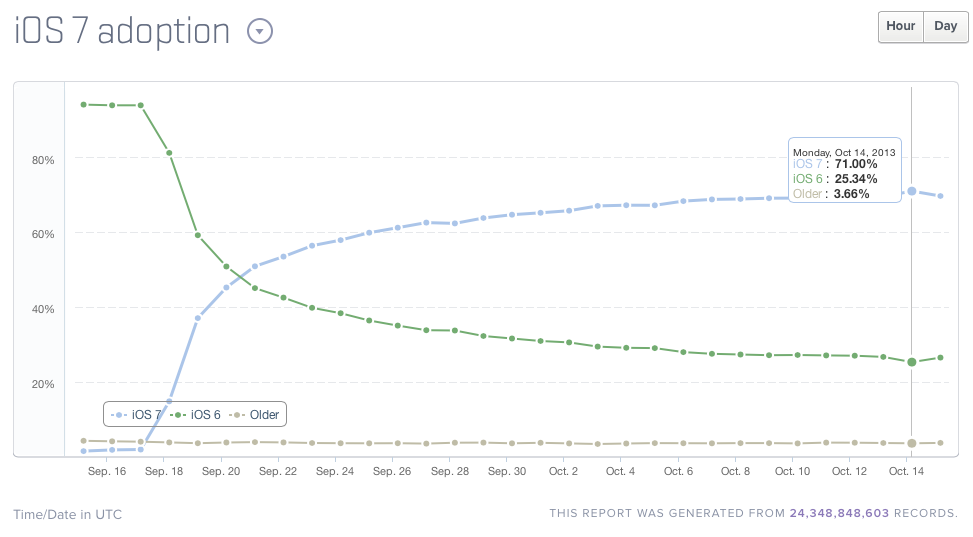
Apple is yet to confirm exactly how many iOS devices are now running iOS 7, but Mixpanel’s data indicates that 350 million are currently in use. That means that over 250 million of them were running the latest software as of Monday.
Data source: CultofMac (By Killian Bell) [via fortune]
Tuesday, May 19, 2015
San Francisco Apple Stores iPhone 5s line wraps around the block

latimes
Three hours before the store is scheduled to open, a line of more that 150 hopeful iPhone buyers stretched down the street and around the block.

Some at the beginning of the line were huddled in blankets (above), having camped overnight for the device. New additions to the line joined every few minutes as the queue stretched down Powell Street and around the corner at OFarrell, in the otherwise quiet Union Square shopping district.


Similarly long lines have been reported in China, which was for the first time ever among the initial countries to participate in the first day of Apples launch, as well as London, Los Angeles, New York and other cities.
One reason the new iPhone is still generating lines at its seventh annual launch is that Apples supply of the iPhone 5s, particularly in the new gold finish, is reported to be in limited supply. Apple has instituted purchasing limits for line holders, restricting iPhone 5c models to ten units per person, while the more scarce iPhone 5s is limited to two devices.
In part, this scarcity is due to production challenges of meeting demand for the new Touch ID sensor. Apple faces the enormous task of building millions of the new devices to meet the anticipated demand over its initial launch weekend, products which must be flawless from day one.
That operational circus act comes just days after the mega-launch of iOS 7, which caused major ripples in the Internet as Apple rolled out the biggest, fastest mobile device upgrade ever.
This is the first time Apple (or anyone) has built such a Touch ID sensor, which improves upon previous, unsuccessful attempts to incorporate practical fingerprint-based authentication into a mobile device.

Apples design uses a new sapphire lens element to protect the fragile capacitive sensor, which industry expert Geppy Parziale had earlier predicted would not stand up to everyday use.
"Constant usage of the sensor starts to destroy the capacitors and over time, the fingerprint sensor stops to work," Parziale gravely warned early last month before Apple had demonstrated how its design worked.
Thousands of fans of Apples product design are ready to wait in line for the new device, expecting that the companys new product works as advertised. Initial product reviews have raved that it does.
Data source: via AppleInsider (By Daniel Eran Dilger)
Subscribe to:
Posts (Atom)